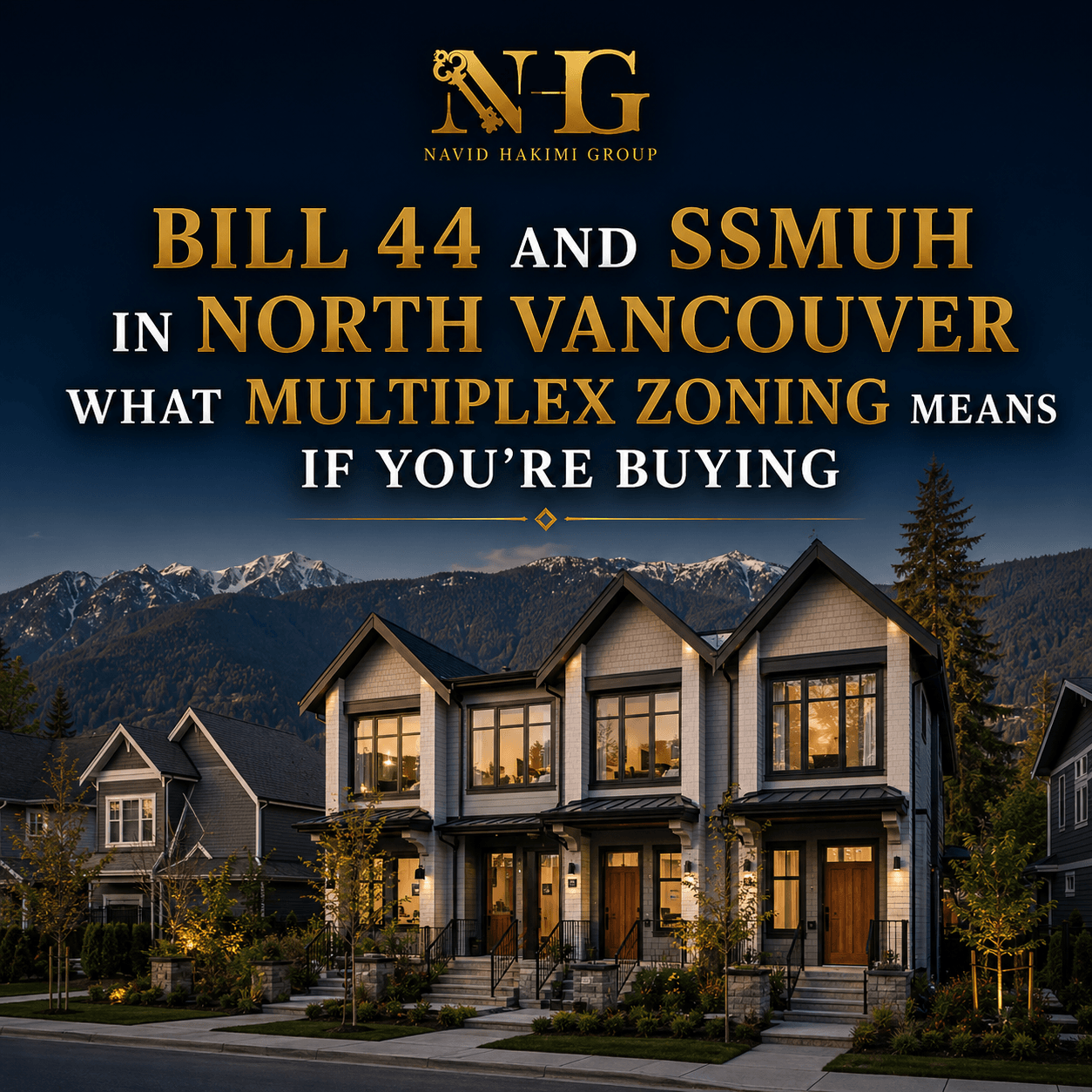
Since the Province brought in Bill 44, every second listing for a North Vancouver house seems to mention “multiplex potential” or “SSMUH ready.” Some of those claims are real. A lot of them are not. Overstated listing copy is one of the red flags in Vancouver home listings that buyers learn to spot. North Vancouver has more excluded land than almost any municipality in Metro Vancouver, both councils have been slow to adopt the newest provincial rules, and what you are actually allowed to build depends heavily on the specific lot. Here is where things really stand and what it means for your purchase.
Quick Answer: What Bill 44 Changed and Who It Affects
Bill 44, passed by the Province in 2023, is the Small Scale Multi Unit Housing legislation. It forces municipalities to allow three to six homes on lots that used to permit one house. The provincial minimums are:
- Up to 3 units on lots under 280 square metres
- Up to 4 units on lots of 280 square metres or more
- Up to 6 units on qualifying lots within 400 metres of frequent transit
Then Bill 25, passed in November 2025, widened where those rules apply and set a compliance deadline of June 30, 2026.
Here is the part most buyers do not know: as of August 2026, neither North Vancouver municipality has adopted a bylaw that fully complies with Bill 25. Both permit up to four units on eligible lots under rules adopted in December 2025. Neither has the six unit allowance in force. The Province can step in with a ministerial order, and there is precedent for it, but nothing has been imposed yet.
If you are buying a normal family home, this changes very little about how you live. If you are buying for development, it changes almost everything about how you underwrite the deal.
Cities where we actively provide real estate buying and selling services to our clients
- realtor north vancouver
- realtor west vancouver
- real estate agent burnaby
- realtor in coquitlam
- realtor in port moody
How Many Units Are Allowed on a North Vancouver Lot Now?
The two municipalities took different routes to roughly the same place.
| City of North Vancouver | District of North Vancouver | |
| Governing rules | Bylaw 9137, Ground Oriented (GO) zone, in force December 2025 | Ground Oriented Housing regulations, December 2025 |
| Units permitted today | Up to 4 units on more than 4,000 properties | Up to 4 units on more than 4,000 properties |
| Six unit allowance | Advanced January 2026, referred back to staff May 2026, not adopted | Council voted 4 to 3 against on April 13, 2026 |
| Height | 3 storeys | About 2 storeys today, 3 storeys proposed |
| Parking | 0.5 stalls per unit | 3 stalls across the property under current 3 unit rules |
| Minimum unit size | 50 square metres | Set by suite and coach house standards |
In the City, the GO zone allows roughly 0.85 FSR on standard lots and up to 1.0 FSR in the higher density corridors, with lot coverage scaling from 30 percent for a single home to 45 percent at five or six units. The parking relaxation to half a stall per unit matters more than it sounds. Without it, denser projects on 33 to 50 foot lots would barely pencil.
Three City areas were carved out of multiplex zoning entirely while a separate Heritage Strategy is worked through: Grand Boulevard, East 19th Street and East 10th Street. If you are shopping there for development potential, check the current status before you assume anything.
In the District, the baseline since June 2024 has been three units on every RS lot, meaning a principal home plus a secondary suite plus a coach house. The December 2025 rules pushed eligible properties to four.
Which Lots Are Excluded: Slope Hazards, Servicing and Flood Areas
This is the single most important section for anyone buying District land with a plan, and it is where North Vancouver differs sharply from flatter municipalities.
The District has roughly 19,961 single family lots. Its own analysis splits them like this:
| Category | Approximate lots | What it means |
| Feasible for multiplex today | 2,900 | Adequate servicing and access |
| Servicing constrained | 8,500 | Needs water, sewer or road upgrades first |
| Natural hazard exempt | 8,583 | Creek, slope or wildfire development permit areas |
That third row is about 43 percent of all single family lots in the District. Those lots sit inside development permit areas for creek corridors and flood hazard, steep slope hazard, or the wildland urban interface. In most hazard scenarios the ceiling stays at three units regardless of lot size.
Being in a hazard area is not always a hard no. Development is often still possible with geotechnical reports and engineered solutions. But it adds cost, adds months, and adds risk to a pro forma. Treat any District lot as hazard affected until the District tells you otherwise.
One more District wrinkle: 319 properties in the Marine Drive corridor, roughly bounded by Hope Road, Pemberton Avenue, Sowden Street and McGuire Avenue, may have their rezoning delayed as late as 2030 because TransLink’s planned Metrotown to North Shore bus rapid transit line runs through the area. Staff have proposed redesignating those properties for higher density instead, which could eventually be worth more than a multiplex. It also means uncertainty for years.
What This Has Done to Land Value and Asking Prices
Two things happened at once, and they pull in opposite directions.
Sellers of eligible lots started pricing in development potential the moment Bill 44 passed. You will see listings with “SSMUH” in the description asking a clear premium over the house next door. At the same time, the detached market has softened, with North Vancouver detached benchmarks down roughly 7 percent from a year earlier.
So the honest answer to “does Bill 44 increase land value” is: it increases the value of lots where a project is genuinely feasible, and it increases asking prices on a lot of lots where it is not. The premium is real where servicing exists, the slope is manageable, the lot is wide enough and the numbers work. It is imaginary on a steep hillside lot inside a creek development permit area.
Do not pay a development premium on a feasibility you have not confirmed. That is the entire lesson of the past two years on the North Shore. For the wider picture, look at whether North Vancouver real estate is a good investment in 2026.
If You Just Want a Family Home: What Actually Changes for You
Most buyers reading this are not developers. Here is your short list, alongside the ongoing carrying costs such as property tax rates in North Vancouver.
- Your neighbourhood may change slowly. Expect occasional three or four unit buildings replacing older houses, mostly near corridors and village centres. This is gradual, not a wave.
- Your resale pool gets bigger. If your lot is eligible, you eventually have both family buyers and builders competing for it. That is a real long term positive, and worth checking against what your property is worth today.
- Parking gets tighter in places. Half a stall per unit near transit in the City means more street parking pressure on some blocks.
- You can still just buy a house. Nothing forces you to build anything. Eligibility is an option, not an obligation.
- Newer multiplex units are a real option. If you have been priced out of detached, a ground oriented three storey unit gives you many of the same benefits at a lower entry point. Weigh it against condo vs townhouse vs detached in North Vancouver.
If You’re Buying for Development: A Feasibility Reality Check
Before you write an offer on a lot for its density, confirm all of these, and check how the BC home flipping tax applies to your exit timeline. Any single failure can sink the project.
- Lot size and OCP designation. In the City, whether you get three, four or six units depends on both lot area and Official Community Plan designation. Over 280 square metres in the right designation is the gate.
- Hazard status. Creek, slope and wildfire development permit areas. In the District this is the most common deal killer.
- Servicing capacity. Water, sanitary, storm and fire flow. About 8,500 District lots need upgrades before extra density is possible, and those upgrades are on you.
- Frequent transit proximity. The six unit tier depends on being within 400 metres of frequent transit, and in both municipalities that tier is not yet in force.
- FSR and coverage math. In the City, 0.85 to 1.0 FSR with coverage capped by unit count, plus permeable and landscaped area minimums that scale with density.
- Timeline risk. Both councils are mid rewrite. Rules could get more generous or the Province could impose them. Either way, do not build a pro forma that assumes a bylaw that does not exist yet.
The primary services our team offers to support your real estate goals
- luxury home for sale
- industrial real estate services
- presale real estate in north vancouver
- first time homebuyer services
How to Check a Specific Property’s Multiplex Potential
The good news is that most of this is checkable in a few days if you know where to look.
- Start with the municipal property lookup. Confirm the zone, lot area, OCP designation and any development permit area overlays on the address.
- Call planning directly. The District’s planning line is 604-990-2480, and the City’s planning department can confirm GO eligibility. Ask specifically about hazard designations and unit count.
- Ask engineering about servicing. This is the question people skip and then regret. Ask what water, sanitary and storm upgrades would be triggered.
- Get a designer to sketch a test fit. Setbacks, height limits and coverage rules often mean the theoretical unit count does not physically fit on the lot.
- Write proper subject clauses. Make the offer subject to satisfactory review of zoning, servicing and geotechnical conditions, and give yourself enough days to actually complete them. Our guide to contract conditions in home buying in BC covers how these are drafted.
Frequently Asked Questions
Can I build four units on my lot in North Vancouver?
Possibly. Both municipalities permit up to four units on more than 4,000 eligible properties each under December 2025 rules. Eligibility depends on lot size, designation, hazard status and servicing.
Is the six unit rule in effect in North Vancouver?
Not as of August 2026. Neither municipality adopted a compliant bylaw by the June 30, 2026 deadline. The City referred its draft back to staff, the District voted against proceeding.
What happens if a municipality misses the provincial deadline?
The Province can issue a formal non compliance notice and ultimately impose zoning by ministerial order. That happened to West Vancouver after the earlier Bill 44 deadline. The two markets differ in more than zoning, as our North Vancouver vs West Vancouver comparison sets out.
Why are so many District lots excluded?
Terrain. About 8,583 lots, roughly 43 percent of the District’s single family stock, sit inside creek, slope or wildfire development permit areas.
Does a hazard designation mean I can never build?
No. It usually means additional geotechnical work, engineering and approvals, and often a cap of three units. It is a cost and timeline issue more than an absolute block.
Does Bill 44 automatically increase what my property is worth?
Only if a project is actually feasible on it. Servicing, slope, lot width and hazard status decide that, not the legislation.
Do I need to strata title the units?
Not necessarily. You can build and hold them as rentals, which is the same logic behind buying a home with a rental suite at a smaller scale. Stratification is a separate decision with its own approval process and cost implications.
Which North Vancouver areas are excluded from multiplex zoning?
In the City, Grand Boulevard, East 19th Street and East 10th Street are carved out pending a Heritage Strategy. In the District, hazard development permit areas do most of the excluding.
What about the properties near the future bus rapid transit line?
Roughly 319 District properties in the Marine Drive corridor may see rezoning deferred to as late as 2030, with higher density designations proposed instead. Expect uncertainty there for several years.
Should I wait for the rules to settle before buying?
Only if your entire plan depends on six units. If you are buying a home to live in, or a lot that already works at three or four units, the current rules are enough to plan around.
North Vancouver Neighbourhoods We Serve
Browse the North Vancouver neighbourhoods where we help buyers and sellers, with current market insight for each area.
- Edgemont Village Townhomes for Sale
- Canyon Heights Realtor
- Realtor in Forest Hills
- Central Lonsdale Realtor
- Realtor in Pemberton Heights
- Realtor in Upper Lonsdale
- Braemar Homes for Sale
- Tempe Property for Sale
- Queensbury Homes for Sale
Looking for a Real Estate Agent in West Vancouver? Explore by Neighbourhood
Every neighbourhood in West Vancouver has its own pricing, inventory, and buyer competition. Choose your area below for local guidance from Navid Hakimi.
- Ambleside Real Estate Agent
- Realtor in Dundarave
- Homes for Sale in Caulfeild
- Real Estate Agent in Whitby Estates, West Vancouver
- Gleneagles Realtor
- West Bay Homes for Sale
- Altamont Real Estate Agent
- Realtor in Eagle Harbour
- Homes for Sale in Chartwell
- Real Estate Agent in Cypress Park Estates, West Vancouver
- Horseshoe Bay Realtor
- British Properties Homes for Sale
Want a Zoning and Feasibility Check on a North Vancouver Property?
“Multiplex potential” in a listing description is marketing. Hazard overlays, servicing capacity, lot geometry and a council that has not adopted the newer rules are reality. The gap between those two is where buyers overpay.
Navid Hakimi runs this check before you write, not after: confirming the actual unit count permitted on the specific lot today, pulling development permit area status, flagging servicing constraints that would land on your budget, and pricing the property on what can genuinely be built rather than what the listing implies.
Send Navid Hakimi the address and get a clear feasibility read before you commit. If the density is real, you will know what it is worth. If it is not, you will know that too, and you can negotiate accordingly.