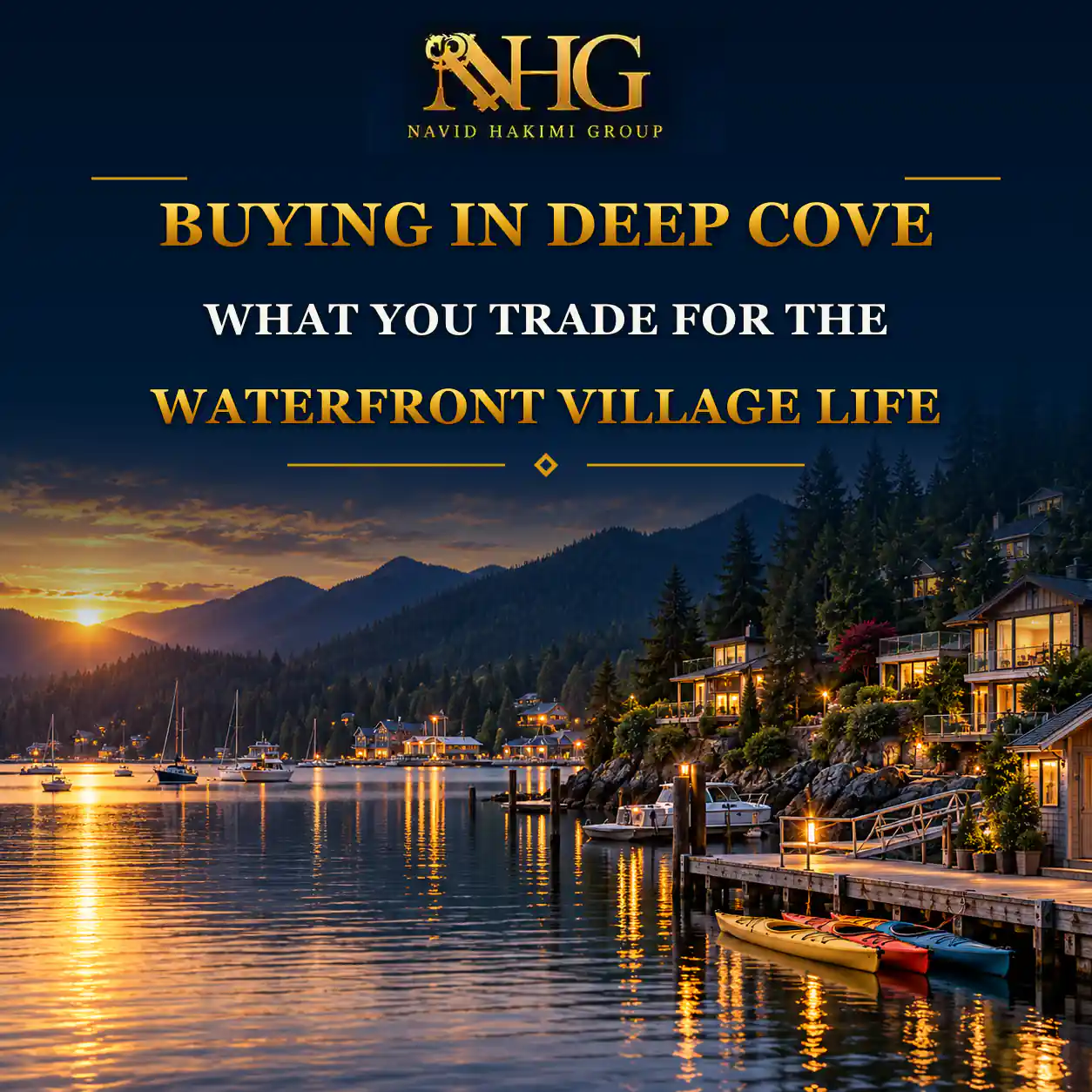
Deep Cove is the postcard of the North Shore: a tiny seaside village, kayaks on calm water, forest trails, and mountains dropping straight into Indian Arm. Living there is as good as it looks. But it comes with a real set of trade offs, from the commute to summer crowds. Here is what anyone looking at Deep Cove real estate should know.
What It’s Like to Live in Deep Cove
Deep Cove feels like a small town at the far eastern edge of North Vancouver. You get a walkable seaside village, excellent outdoor access (Quarry Rock, Mount Seymour, paddling on Indian Arm) and a close knit community.
In exchange, you give up convenience. The commute to downtown is one of the longest on the North Shore, the village fills with visitors every summer weekend, many homes are on steep lots, and waterfront properties come with extra rules around docks and foreshore. Houses in the area mostly sold between about $1.5 million and $2.6 million in 2026, with waterfront homes well above that.
If you work from home, work on the North Shore or value lifestyle over commute time, Deep Cove is one of the best places in Metro Vancouver to live, and one of the top picks in our guide to outdoor lifestyle homes in North Vancouver. If you drive downtown every day, think hard about it.

Deep Cove Real Estate Prices: What Homes Cost Right Now
Deep Cove real estate is mostly detached homes, with a small number of townhomes and condos.
| Home type | Typical price range in 2026 | Notes |
|---|---|---|
| Older detached home | about $1.5M to $2M | Often 1960s and 1970s homes, many on sloped lots |
| Updated or newer detached home | about $2M to $2.7M | Renovated or rebuilt, sometimes with views |
| View home | about $2.5M to $4M | Water and mountain views, often on Panorama Drive or the hillside |
| Waterfront home | $3.5M to $8M plus | Rare, price depends on frontage, dock and access |
| Townhome or condo | limited supply | Few options; they sell fast when they come up |
For context, the average house sale in Deep Cove in April 2026 was about $2.22 million, with sales from $1.55 million to $2.64 million. The North Vancouver detached benchmark was about $2.09 million in August 2026, and the wider market was down around 7% from a year earlier, so buyers have a bit more leverage than in past years.
The Sub Areas: The Village, Panorama, Strathcona and Indian River
“Deep Cove” gets used for a wider area than just the village. Each part feels different:
- The Village. The few blocks around Gallant Avenue and Deep Cove Road. Walk to cafés, the famous doughnut shop, the park, kayaking and the Shaw Theatre. Homes here are the most in demand, and parking is the biggest headache.
- Panorama. Along Panorama Drive and the streets above it. Some of the best water views and some true waterfront homes, but also steep driveways and winding roads.
- Strathcona. Quieter residential streets near the village. More typical family homes, gentler lots in places, and a short drive or a longer walk to the water.
- Indian River. The wooded streets around Indian River Drive, a little further from the village and closer to Mount Seymour. More private, some larger lots, and more of a drive to the shops.
Nearby Cove Cliff, Dollarton and Woodlands are often grouped with Deep Cove too. Woodlands and the Indian Arm shoreline in particular are more remote, and some homes there are reached only by boat.
The Real Commute: Deep Cove to Downtown, to Lonsdale and to the Highway
This is the biggest trade off.
| Trip | Off peak | Rush hour |
|---|---|---|
| Deep Cove to Highway 1 (Ironworkers Memorial Bridge) | 10 to 15 min | 20 to 35 min |
| Deep Cove to Lonsdale | 20 to 25 min | 30 to 45 min |
| Deep Cove to downtown Vancouver | 30 to 40 min | 50 to 75 min |
| Deep Cove to Park Royal | 25 to 30 min | 40 to 60 min |
Everything leaves through Dollarton Highway or Deep Cove Road and funnels toward the Ironworkers Memorial Bridge, which is one of the busiest pinch points in the region. Transit is local buses to Phibbs Exchange, then a transfer, so downtown by bus usually takes an hour or more.
If you work downtown full time and drive, this commute will be part of your life. If you are hybrid, work from home, or work in North Vancouver or Burnaby, it is much easier. See our guide to commute times from North Vancouver to downtown for other areas.

Waterfront and View Properties: Docks, Foreshore Leases and What You Actually Own
Buying on the water in Deep Cove is not like buying a regular house. The key thing to understand: your lot usually ends at the high water mark. The water and seabed in front of it (the foreshore) are not yours.
In Deep Cove and Indian Arm, the foreshore is managed by the Vancouver Fraser Port Authority, which handles dock and water lot permits. That affects you in a few ways:
- Docks need a lease or licence from the port authority. A dock without one is technically trespassing.
- Annual fees. Recreational dock lease fees in Deep Cove are now around $2,000 a year, much higher than they used to be.
- New docks are harder. The port paused new dock applications for years. It now accepts them again, but with strict environmental rules, and some sensitive areas are off limits.
- Shared docks. Some docks are shared between neighbours, with legal agreements that come with the property.
Before you buy a waterfront home, confirm whether the dock is properly licensed, what the lease costs, when it renews, and whether it can transfer to you. Also check for any shoreline erosion, retaining walls or seawall repairs.
View homes have their own questions. Is the view protected, or could trees or a new build block it? Are there covenants on title? On a sloped lot, what does the geotechnical picture look like?
Slope, Septic, Wells and Older Infrastructure: The Due Diligence That Matters Here
Deep Cove’s beauty comes from its terrain, and that terrain affects the homes:
- Steep lots. Many homes sit on slopes. Check drainage, retaining walls, and any geotechnical reports. The District may require a geotechnical engineer for new building permits.
- Older homes. A lot of Deep Cove homes are 50 to 60 years old. Look for original wiring, galvanized pipes, old roofs and single pane windows.
- Oil tanks. Older homes may have had oil heat. Get a tank scan.
- Sewer lines. A sewer scope is a must on older homes, especially with lots of trees and roots.
- Septic and wells. The main Deep Cove area is on municipal water and sewer, but some homes in the more remote parts, especially along Indian Arm and in parts of Woodlands, use septic systems or private water. These need specialist inspections.
- Wildfire and storms. Heavily treed lots bring wind storm and interface fire considerations, and may affect insurance.
Our guide to slopes, creeks and flood risk on the North Shore covers what to check.

Tourism Season: Quarry Rock Crowds, Parking and Summer Traffic
Deep Cove is one of the most visited spots on the North Shore. From late spring to early fall:
- Quarry Rock brings thousands of hikers, especially on weekends.
- Kayak and paddleboard rentals fill the waterfront.
- Parking gets tight. The District has added paid parking and resident only parking on many village streets, and runs traffic control on busy days.
- Lineups at the doughnut shop and cafés are part of the summer experience.
For residents, it means planning trips around peak weekend times and sometimes dealing with visitors parked on your street. In the off season, the village is quiet and very much a local place.
Schools, Groceries and Everyday Services
Schools in the area include:
| School | Level |
|---|---|
| Sherwood Park Elementary | K to 7 |
| Cove Cliff Elementary | K to 7 |
| Seycove Secondary | 8 to 12 |
| Dorothy Lynas Elementary | French immersion, K to 7 |
Always confirm catchment with the North Vancouver School District for the specific address.
Groceries and services. The village has cafés, restaurants, a few shops and basic services. For bigger grocery runs, most residents go to Parkgate Village, about 10 minutes away, which also has a community centre, library, pharmacy and more. For big box stores and major shopping, it is a longer drive toward Lonsdale, Park Royal or across the bridge.
Who Deep Cove Suits and Who It Doesn’t
| Deep Cove is a great fit if you | Deep Cove may not suit you if you |
|---|---|
| Work from home or on the North Shore | Drive downtown every weekday |
| Love hiking, paddling and trail running | Want to walk to lots of shops and restaurants |
| Want a small town, community feel | Want quick access to rapid transit |
| Are happy trading space for lifestyle | Do not want to deal with summer crowds |
| Value water and mountain views | Want a flat lot and a simple, low maintenance house |
Frequently Asked Questions
Is Deep Cove part of North Vancouver?
Yes. It is in the District of North Vancouver, at its eastern edge.
Is Deep Cove expensive?
Yes, compared with most of North Vancouver for detached homes, especially waterfront and view properties.
Can I build a dock at my waterfront home?
Possibly, but you need approval and a lease from the Vancouver Fraser Port Authority, and some areas are off limits.
Is there a grocery store in Deep Cove?
There are small shops in the village. Most residents do their main grocery shopping at Parkgate Village.
How long is the drive from Deep Cove to downtown Vancouver?
About 30 to 40 minutes off peak and 50 to 75 minutes at rush hour.
Is Deep Cove good for families?
Yes, especially for outdoorsy families. Schools, parks and trails are close, but daily errands may need the car.
Does Deep Cove get busy in summer?
Very. Weekends from May to September bring big crowds for Quarry Rock and kayaking.
Are there condos in Deep Cove?
Very few. Most of the housing is detached, so condos and townhomes are limited.
Curious About Deep Cove? Let’s Walk Through What’s Listed
Deep Cove is one of those places where every street, and sometimes every lot, is different. A waterfront home with a licensed dock is a completely different purchase from a hillside view home or a family house near Seycove.
Navid Hakimi can walk you through what is on the market right now, what has recently sold, and the specific questions to ask about docks, slopes and older homes before you make an offer. Browse Navid’s current listings, or set up a Deep Cove tour with Navid.
Prices and market information current as of September 2026. Confirm dock, foreshore and school details for any specific property.