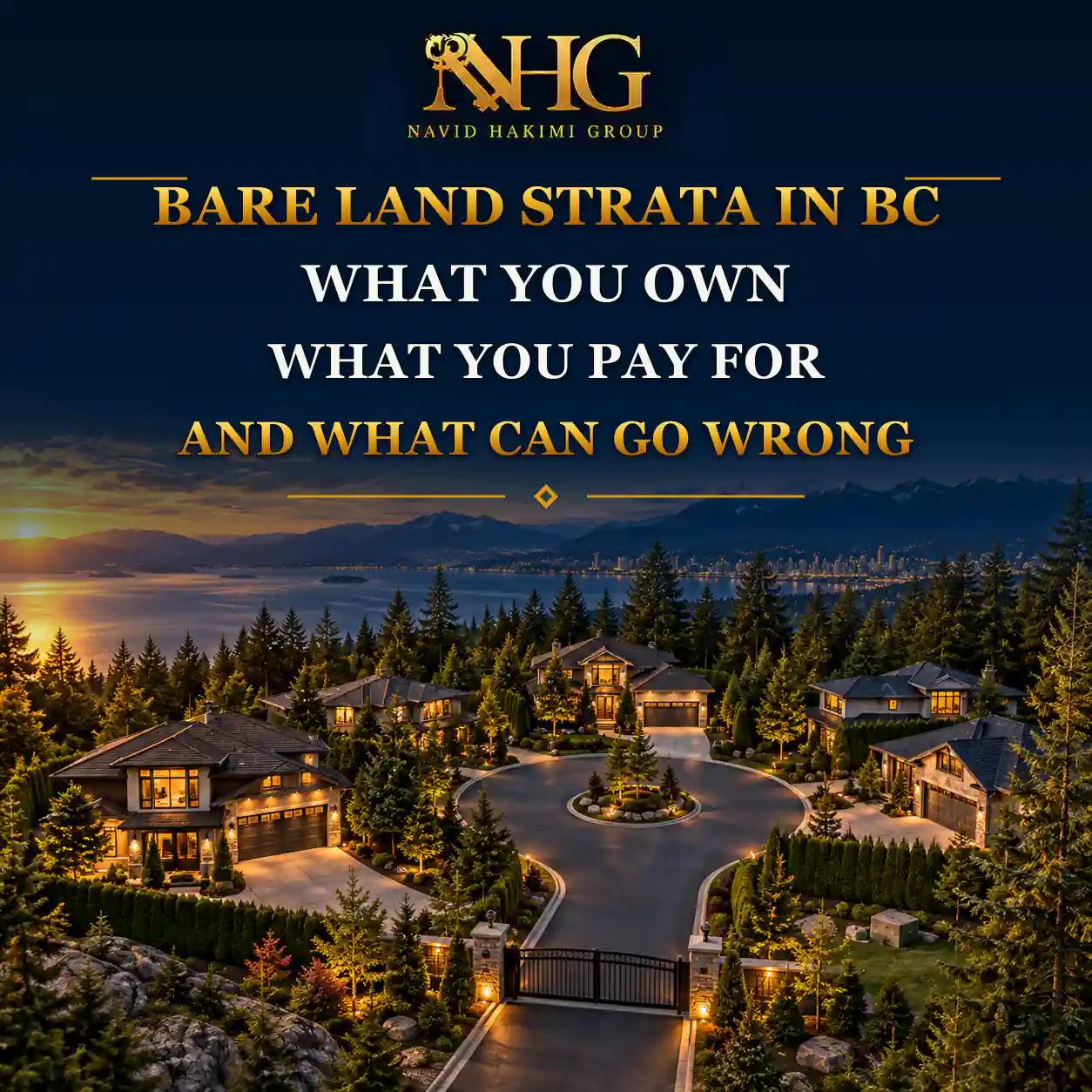
You found a detached house you love, then you see “bare land strata” in the listing and a monthly fee. Wait, isn’t a house supposed to be freehold? Not always. Here is what a bare land strata in BC really means, what you own, what you pay for, and where buyers get tripped up.
What Is a Bare Land Strata?
A bare land strata is a strata where you own the lot and the house on it, just like a regular house, but you share some things with the neighbours, like a private road, a water system, landscaping or a gate. Those shared items are common property, owned and managed by the strata corporation, and you pay strata fees to look after them.
So it feels like owning a detached house, but legally you are part of a strata. You have bylaws, a council, annual general meetings and a contingency reserve fund, and you need to read the strata documents before you buy, the same as you would for a condo.
What You Own: The Lot Boundary vs the Building
In a regular condo strata, your unit’s boundaries are the walls, floors and ceilings. In a bare land strata, the boundary is the surveyed lot lines on the ground. Everything inside those lines is yours:
- The land itself
- The house and any garage or shed on it
- Your driveway (usually), yard and fences
- Your roof, siding, windows and foundation
What you do not own on your own is everything outside your lot lines that is shown as common property on the strata plan. That usually means:
- The private road and sidewalks
- Street lighting, signs and any entry gate
- Shared water, sewer or stormwater lines (and sometimes a septic field)
- Landscaped common areas, trails, a clubhouse or other amenities
Because you own the house, you are responsible for maintaining and insuring it yourself. If your roof needs replacing, that is your bill, not a strata special levy. This is the single biggest difference from a townhouse or condo strata.
Bare Land Strata vs Conventional Strata vs Freehold
| Freehold house | Bare land strata | Conventional strata (condo or townhouse) | |
|---|---|---|---|
| What you own | Lot and house | Lot and house | Your unit, plus a share of common property |
| Who maintains the building exterior | You | You | The strata |
| Who insures the building | You | You | The strata |
| Strata fees | None | Usually lower, often $100 to $500 a month | Usually higher, often $400 to $900 plus a month |
| Bylaws | Municipal rules only | Municipal rules plus strata bylaws | Municipal rules plus strata bylaws |
| Special levies | None | Possible for roads, pipes, shared systems | Possible for roofs, envelope, elevators, and more |
| Rental rules | Municipal rules only | Short term rentals can be banned; long term bans mostly gone since 2022 | Same as bare land strata |
| Depreciation report | No | Often required | Required |
Think of a bare land strata as a middle ground: more freedom than a condo, more rules than a regular house. Note that BC’s 2022 changes removed most strata rental bans, so rental restrictions are far less common than they used to be.

What the Strata Fees Cover: Private Roads, Water, Sewer and Snow Clearing
Fees vary a lot, because every bare land strata shares different things. Typical line items:
- Private road repairs and repaving. Resurfacing a private road can easily run into six figures.
- Snow clearing and sanding. On North Shore hillsides, this can be a real cost every winter.
- Street lighting, gates and signs.
- Shared water, sewer or storm lines. Older systems can be expensive to replace.
- Landscaping of common areas.
- The strata’s insurance on common property and any shared buildings.
- Management fees if the strata uses a property manager.
- Contributions to the contingency reserve fund.
A strata with a long private road, a gate, a pump station and a clubhouse will have much higher fees than one that simply shares a short driveway. Always look at what is included, not just the monthly number.
Why the Contingency Reserve Fund Matters More Here
In a condo, the reserve fund pays for the roof, the envelope and the elevator. In a bare land strata, it pays for the road, the pipes and the shared systems. These are fewer items, but they are big and easy to forget about.
The problem is that many bare land stratas keep their fees low for years because “nothing ever breaks.” Then the road needs repaving or an underground water line fails, and the reserve fund cannot cover it. That turns into a special levy split among a small number of owners, which can mean $10,000 to $50,000 each in a small strata.
Before you buy, check:
- The current contingency reserve fund balance
- The depreciation report (it shows what needs replacing and when, and whether the fund is on track)
- The last two years of AGM and council minutes for talk of roads, drainage or water problems
- Any approved or proposed special levies (they will show up on the Form B)
Our guides to strata depreciation report red flags and reading a Form B line by line show you exactly what to look for.

Building and Renovating: The Bylaws That Limit What You Can Do
This is where many buyers get surprised. Even though you own the house, the strata bylaws can control what it looks like and what you can build. Common restrictions include:
- Architectural controls. Paint colours, roofing materials, fencing styles and even landscaping may need approval.
- Size and height limits on additions, garages or second storeys.
- Suites and coach houses. The municipality may allow them under the new small scale multi unit housing rules, but some strata bylaws still limit them or require approval.
- Tree removal and changes to grading or drainage.
- Parking and RV storage rules.
- Short term rental bans.
If you are buying to renovate, knock down and rebuild, or add a suite, read the bylaws before you remove subjects. A dream plan that the strata will not approve is a costly mistake. For more on what the municipality allows, see our guide to Bill 44 and multiplex zoning in North Vancouver.
Financing and Insurance Differences Buyers Get Caught By
Financing. Most lenders treat a bare land strata home much like a regular house, but they may ask for the strata documents and look closely at the fees, the reserve fund and any special levies. A few situations can make lenders cautious:
- Shared septic systems or private water systems
- Very small stratas with a weak reserve fund
- Pending lawsuits or large special levies
Insurance. This is where the biggest mistakes happen. Because the strata does not insure your house, you need a regular homeowner policy, not a condo policy. A condo policy assumes the strata covers the building, so it will leave your house seriously underinsured. You should also add loss assessment coverage in case the strata’s deductible or an uninsured loss gets split among owners. The province’s page on strata owner insurance sets out who insures what.
Talk to your insurance broker before you remove subjects and tell them clearly that it is a bare land strata.
Where Bare Land Strata in BC Shows Up on the North Shore
Bare land stratas are less common on the North Shore than in the Fraser Valley or the Okanagan, but you will see them. They tend to show up as:
- Private cul de sacs of detached homes, where the developer built a private road instead of a public one
- Hillside enclaves in areas like Seymour, upper Lynn Valley and parts of West Vancouver, where terrain made a shared road and shared services the practical choice
- Gated streets of higher end homes
- Some duplex and small infill developments, where each owner has their own lot but shares a driveway and services
The listing will usually say “bare land strata” or show a strata fee on a detached home. If you see a monthly fee on a house, ask right away.
Frequently Asked Questions
Is a bare land strata freehold?
You own your lot in fee simple, but it is still a strata, so you are bound by the bylaws and must pay strata fees.
Can I be forced to pay a special levy on a bare land strata?
Yes, if owners vote to approve one for common property, such as a road or a water line.
Who insures the house in a bare land strata?
Usually you do. The strata insures common property only, so you need a full homeowner policy.
Are bare land strata fees tax deductible?
Not for a home you live in. If you rent it out, they can usually be claimed as a rental expense.
Can I build a suite in a bare land strata home?
Maybe. The municipality has to allow it, and the strata bylaws must not prohibit it.
Do bare land stratas need a depreciation report?
Most do. The rules now require depreciation reports for most stratas every five years, with limited exceptions for very small ones.
Can a bare land strata restrict rentals?
Long term rental bans were largely removed in 2022, but stratas can still restrict short term rentals.
Is a bare land strata a good investment?
It can be. You get house style ownership with shared costs for the road and services, but resale buyers will ask the same questions you are asking now.
Looking at a Bare Land Strata? Let’s Read the Bylaws First
A bare land strata can be a great way to own a detached home on a quiet private street. It can also hide a road that needs repaving, a thin reserve fund or bylaws that kill your renovation plans. The difference is in the paperwork.
Navid Hakimi reviews the strata documents, bylaws, minutes and depreciation report with you before you commit, and flags anything that could cost you later. Send Navid the listing you are looking at and he will go through the paperwork with you.
Current as of September 2026. This is general information, not legal or insurance advice. Always review strata documents with your lawyer or notary before removing subjects.