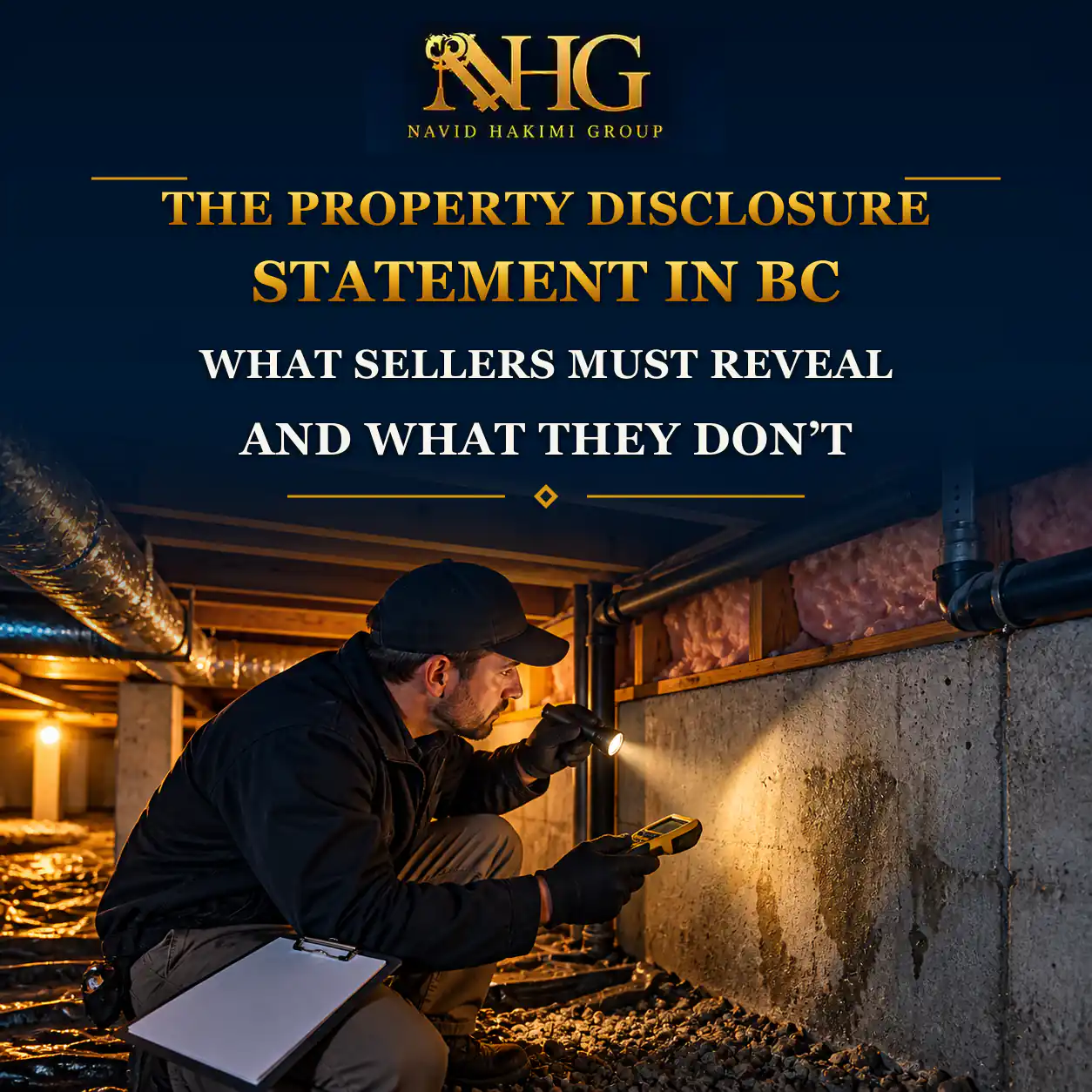
A Property Disclosure Statement, or PDS, is a form where the seller answers roughly fifty yes or no questions about the property, based on what they personally know. Leaks, flooding, structural repairs, unpermitted work, drug use in the home, and so on.
What Is a Property Disclosure Statement? (Short Answer)
Two things to understand right away. It is not mandatory in BC and it is not a warranty. It is a statement of the seller’s knowledge, and “I don’t know” is a permitted answer. It is useful evidence, not a guarantee, and it is not a substitute for an inspection. What a North Vancouver home inspection actually covers is a separate exercise entirely.

What the PDS Actually Asks the Seller
The standard form runs through several groups of questions:
- Land: boundary disputes, encroachments, easements, drainage and flooding history
- Services: water source and quality, septic or sewer, well records
- Building: roof leaks, moisture or water damage, structural problems, insulation type, asbestos, underground oil tank
- Additions and alterations: renovations, and whether permits were obtained and finalized
- Occupancy and use: whether it was ever used to grow or manufacture illegal substances, whether there has been meth contamination
- Strata specific: for condos and townhouses, questions about levies, rentals, pets and parking
- General: legal non conforming use, outstanding work orders, moisture in the walls
Each is answered Yes, No, or Do Not Know, plus space for comments. On the North Shore the drainage and slope questions deserve extra attention, for the reasons set out in our guide to slopes, creeks and flood risk on North Shore lots.
“I Don’t Know”: The Answer That Protects Sellers and Worries Buyers
This is the heart of the PDS, and it is where buyers most often misread the document.
A “Do Not Know” answer is completely legitimate. An estate executor selling a parent’s house genuinely does not know if the roof leaked in 1998. An investor who never lived there does not know either.
But it is also, honestly, the safe answer for a seller who would rather not say. And since liability attaches to a false statement rather than to an admission of ignorance, “Do Not Know” carries very little risk for the person filling out the form.
How to read it as a buyer:
| Pattern | How to treat it |
| Mostly clear Yes and No answers, a few notes | Normal. The seller engaged with the form |
| “Do Not Know” on almost everything | The document tells you nothing. Rely entirely on your inspection |
| “Do Not Know” on one specific high value item | Ask directly. This is the question to follow up |
| No PDS provided at all | Common with estates and foreclosures. Not sinister, but inspect harder |
The rule of thumb: a PDS full of “Do Not Know” is not a red flag about the house, it is a signal that you have to do the work yourself. It belongs alongside the other red flags worth spotting in a Vancouver listing.
Cities where you can receive our professional real estate buying and selling services
- real estate agent in north vancouver
- real estate agent in west vancouver
- real estate agent in burnaby
- real estate agent in coquitlam
- real estate agent in port moody

Latent vs Patent Defects: What Must Be Disclosed Either Way
This distinction matters more than the form itself, because it applies whether or not a PDS exists.
Patent defect. A problem visible on reasonable inspection. A cracked window, a stained ceiling, a sagging deck. In BC the buyer bears the risk of patent defects. The seller does not have to point them out. This is where “buyer beware” still genuinely applies.
Material latent defect. A defect that cannot be discovered through a reasonable inspection and that makes the property dangerous, unfit to live in, or unfit for a purpose the buyer has made known. BCFSA describes it as covering defects that involve great expense to remedy, that breach a local government notice, or that reflect work done without required permits.
Material latent defects must be disclosed, PDS or no PDS. Common examples:
- A basement that floods, but only in heavy rain
- Structural damage hidden behind finished walls
- An unpermitted suite or unpermitted electrical or gas work
- A buried oil tank
- Water infiltration inside the envelope
- Contamination from a former grow operation
- Unsafe water quality on a well
Unpermitted suites are the version of this that comes up most often in North Vancouver housing stock, and our guide to secondary suites and coach houses under City and District rules explains why so many of them were never finalized. Water infiltration inside the envelope is the strata version, covered in leaky condos and building envelopes on the North Shore.
Real estate licensees have a further duty here. If a seller knows about a material latent defect and refuses to disclose it, the licensee must disclose it themselves, and if the seller tries to stop them, the licensee must stop providing services to that seller.
Is a PDS Mandatory in BC?
No. There is no legislated requirement and no prescribed form. In practice most residential listings include one because buyers expect it and its absence raises questions.
You will most often see a sale without a PDS in:
- Estate sales, where the executor never lived in the home
- Foreclosures and court ordered sales
- Investor owned properties
- New construction, where the warranty documents do the job instead
None of these are warning signs by themselves. They just shift more weight onto your inspection and your subject conditions. Estate sales in particular follow their own timetable, which we cover in probate fees and selling an inherited home in BC.
What a PDS Does Not Protect You From (and Why You Still Inspect)
A PDS does not:
- Certify that anything is in good condition
- Cover what the seller did not know
- Replace a home inspection, a strata document review, or a title search
- Guarantee that permits were finalized, even where the seller answered yes
The PDS is normally attached to the contract as a representation, not a warranty. That distinction is legally significant. It means you may have a remedy for a false statement, but you do not have a remedy simply because something turned out to be broken.
Your actual protection is the subject clause package: subject to inspection, subject to financing, subject to review of title and strata documents. Our guide to contract conditions in a BC purchase sets out how each one works. For the unpermitted work the form may not capture, title insurance in BC is the backstop worth understanding. The PDS points your inspector where to look. It does not do their job.
Not sure whether an answer on a disclosure statement is routine or worth pushing on? That judgment call is where a local agent earns their fee. Navid Hakimi reads these against what is normal for North Shore housing stock, where a 1970s Lynn Valley home and a 2015 Lower Lonsdale condo raise completely different questions.
Specialized North Shore services
- luxury homes for sale in North Vancouver
- presale real estate services in North Vancouver
- first-time home buyer services in North Vancouver
- commercial and industrial real estate services
For Sellers: How to Complete It Without Creating Liability
Straightforward rules:
- Answer honestly. A knowingly false answer is the one thing that creates real exposure.
- Use “Do Not Know” when it is true, not as a hiding place. If you fixed it, you know about it.
- Disclose and describe. “Yes, roof leak in 2019, repaired by ABC Roofing, invoice available” is far safer than a bare yes, and far safer than a no.
- Do not guess about permits. If you are not sure a permit was finalized, say so and let the buyer check with the municipality.
- Keep your paperwork. Invoices and permits turn a scary yes into a resolved issue.
- Never let a licensee talk you into vagueness, and never ask one to conceal a known defect.
Sellers consistently underestimate how much a documented, repaired problem reassures buyers, and overestimate the damage of admitting it. Disclosure with receipts sells homes. Silence that later unravels costs far more. If you are getting a listing ready, our guide to preparing a North Vancouver home for sale covers what to document alongside what to fix.
What Happens If a Seller Lies on the PDS
The buyer’s usual claim is negligent or fraudulent misrepresentation. To succeed they generally need to show the statement was false, that the seller knew or ought to have known, that the buyer relied on it, and that they suffered a loss.
Possible outcomes range from damages for the cost of repair to, in serious cases, rescission of the contract. Practically, most disputes settle, and most litigation is slow and expensive relative to the amount at stake. Whether a lawyer or a notary is handling your file matters here, and the difference between the two roles in a BC conveyance is worth knowing before a dispute rather than after.
Which is the real lesson for buyers: do not plan to be made whole later. Get the inspection, ask the follow up questions during the subject period, and price the risk while you still have the option to walk.
Frequently Asked Questions
Is a PDS legally required in BC?
No. It is customary but not mandatory, and there is no prescribed form.
Can I refuse to provide one as a seller?
Yes. Executors and investors often do. Expect buyers to ask why and to inspect more thoroughly.
Does a PDS become part of the contract?
Only if the contract says so, and it usually does, as a representation rather than a warranty.
What is the difference between a latent and a patent defect?
Patent defects are visible on reasonable inspection and are the buyer’s risk. Material latent defects are hidden and must be disclosed.
Does a seller have to disclose a death in the home?
BC does not treat that as a material latent defect. A physical hazard such as meth contamination is a different matter and must be disclosed.
Does an unpermitted suite have to be disclosed?
Work done without required permits generally falls within material latent defect territory, so yes.
What if the seller genuinely did not know?
Then there is usually no misrepresentation. This is why inspections and subject conditions matter more than the form.
Can I sue over a problem found after completion?
Possibly, if it was a material latent defect the seller knew about or a false statement on the PDS. It is slow and expensive, so prevention beats litigation.
Does a PDS replace a home inspection?
No, and it is not intended to. It tells your inspector where to look.
Is a PDS used for new construction?
Rarely. New homes come with a 2 5 10 warranty and builder documentation instead.
Buying or Listing on the North Shore? Let’s Review the Disclosure Together
Most disputes over disclosure trace back to a question that was answered vaguely and never followed up during the subject period, when it would have cost nothing to sort out.
Navid Hakimi works through disclosure statements with North Shore buyers and sellers as a normal part of the process: what to ask about, what to document, and what a given answer actually means for a home of that age and type.
Reach out before you write an offer or sign a listing agreement, or start with a free evaluation of your North Shore home, and get the disclosure handled properly the first time.
General information current as of September 2026, not legal advice. For a specific disclosure question, consult a BC real estate lawyer.
North Shore Neighbourhoods We Serve
- Homes for Sale in Edgemont Village
- Canyon Heights Real Estate Agent
- Forest Hills Realtor
- Realtor in Central Lonsdale
- Real Estate Agent in Pemberton Heights
- Real Estate Agent in Upper Lonsdale
- Realtor in Braemar
- Homes for Sale in Tempe
- Queensbury Real Estate Agent
- Homes for Sale in Ambleside
- Real Estate Agent in Dundarave
- British Properties Real Estate Agent