You have got $100,000 saved. That is a serious accomplishment and it feels like it should unlock a lot. So the natural question is: what does it actually buy on the North Shore? The answer surprises most people in two directions. Your down payment stretches further than you expect under Canada’s minimum down payment rules. And your income, not your savings, is almost certainly what decides your real ceiling. Let us work through it properly.
Your Realistic Price Range
With $100,000 down, the mortgage rules technically allow you to purchase up to about $1.25 million. What most households with $100,000 saved actually end up buying in North Vancouver is between $700,000 and $900,000, because income and the stress test bind before the down payment does. Here is the split:
| Price it allows | Reality check | |
| What the down payment rules allow | up to about $1,250,000 | Requires roughly $260,000 household income to qualify |
| What a $180,000 household income supports | roughly $850,000 | This is the common landing spot |
| What a $130,000 household income supports | roughly $600,000 to $650,000 | Still a real North Vancouver home |
| What twenty percent down buys with no insurance | $500,000 | Lower payment, less flexibility |
In North Vancouver terms, that $700,000 to $900,000 range puts you in a comfortable one bedroom or a solid two bedroom condo, in a decent building, often with parking. It does not reach a townhouse, which typically starts around $1.25 million locally, and it does not reach detached, which averages well over $2 million. If you are still weighing the format, our comparison of condo vs townhouse vs detached sets out what each one costs to own. Cities where you can receive our professional real estate buying and selling services
- real estate agent in north vancouver
- real estate agent in west vancouver
- real estate agent in burnaby
- real estate agent in coquitlam
- real estate agent in port moody
Don’t Spend It All: Closing Costs Come Out of the Same $100K
This is the single most common budgeting mistake, and it catches people two weeks before completion when the lawyer sends the statement of adjustments. Your $100,000 is not all down payment. Some of it has to cover the costs of actually closing the deal, and the full list is in hidden costs of buying.
| Closing cost | Typical amount | Notes |
| Property Transfer Tax | $0 for first time buyers up to $835,000, otherwise roughly $14,000 on an $800,000 purchase | The biggest single variable. Check your eligibility against the property transfer tax exemptions |
| Legal or notary fees | $1,200 to $2,000 | Includes title searches and registration |
| Home inspection | $400 to $700 | Non negotiable in my view |
| Strata document review | $150 to $400 | Sometimes bundled with legal |
| Appraisal | $300 to $500 | Often required by the lender |
| Title insurance | $200 to $400 | Common, sometimes lender required |
| Adjustments at closing | $500 to $2,000 | Prepaid property tax and strata fees you reimburse the seller |
| Moving | $800 to $3,000 | More if you are moving a household rather than a suite |
| Immediate setup costs | $1,000 to $5,000 | Blinds, appliances, paint, the things nobody budgets for |
Lenders also want to see reserves after closing. A common guideline is one and a half percent of the purchase price left over, which on an $800,000 purchase is $12,000. Some lenders are stricter, some are more relaxed, but arriving at completion with zero dollars is a bad plan regardless of what the lender requires.
Your True Working Budget After Costs
So let us convert $100,000 into a real number.
| Scenario | Closing costs | Reserve to keep | Working down payment |
| First time buyer, under $835,000 | about $5,000 to $8,000 | $8,000 to $12,000 | $80,000 to $87,000 |
| Not a first time buyer, $800,000 purchase | about $19,000 to $22,000 | $8,000 to $12,000 | $66,000 to $73,000 |
| First time buyer, new construction | about $5,000 to $8,000, plus GST considerations | $8,000 to $12,000 | $80,000 to $87,000, with the GST rebate potentially returning up to $30,000 |
Notice what that first time buyer status is worth. On an $800,000 purchase it is roughly $14,000 straight back into your down payment, which is the difference between an eight percent and a ten percent down payment. That is not a rounding error. Our North Vancouver affordability guide shows how far that status moves the numbers across every price band.

How That Budget Translates Into a Purchase Price
Canada’s minimum down payment rules work in tiers:
- 5 percent on the first $500,000 of the purchase price
- 10 percent on the portion between $500,000 and $1,500,000
- 20 percent on anything above $1,500,000, and mortgages above that price cannot be insured at all
Run that backwards from $100,000: five percent of $500,000 is $25,000, leaving $75,000 to cover ten percent of the portion above, which supports another $750,000. Total: $1,250,000. The tiers, and how CMHC premiums attach to them, are set out in how much down payment you need. Then mortgage default insurance gets added on top. At a down payment between 5 and 9.99 percent the premium is 4.00 percent of the mortgage, at 10 to 14.99 percent it is 3.10 percent, and at 15 to 19.99 percent it is 2.80 percent. At twenty percent or more there is no premium at all. The premium is normally added to your mortgage balance rather than paid in cash, and there is no PST on it in British Columbia.
One more lever: thirty year amortization is available on insured mortgages for first time buyers and for purchasers of newly built homes. It lowers your monthly payment by roughly seven to eight percent, which also helps you qualify. It costs you meaningfully more interest over the life of the loan, so it is a tool, not a free lunch. What you pair it with matters too, so read mortgage options for first-time buyers and settle the fixed or variable mortgage question early.
Three Scenarios Compared Side by Side
All three use the same $100,000 and an illustrative 4.5 percent rate. Pricing moves, so check current mortgage rates in Vancouver and rerun your own figures in the mortgage calculator. Notice how differently they behave.
| Maximum leverage | Balanced | Conservative | |
| Purchase price | $1,250,000 | $850,000 | $500,000 |
| Down payment | $100,000 (8 percent) | $72,000 (8.5 percent) | $100,000 (20 percent) |
| Mortgage before insurance | $1,150,000 | $778,000 | $400,000 |
| Insurance premium | $46,000 | $31,120 | none |
| Total financed | $1,196,000 | $809,120 | $400,000 |
| Amortization | 30 years | 30 years | 25 years |
| Monthly payment at 4.5 percent | about $6,060 | about $4,100 | about $2,223 |
| Qualifying payment at the stress test rate | about $7,560 | about $5,114 | about $2,701 |
| Household income needed, roughly | $260,000 | $180,000 | $103,000 |
| Cash left after closing | almost nothing | about $15,000 to $20,000 | none, it all went to the down payment |
The lesson in that table is not that one column is right. It is that the maximum leverage column is mostly theoretical for anyone with $100,000 saved, because the income it demands is far above what most people saving that amount actually earn. And the conservative column, while safe, buys you a home most people would find limiting on the North Shore. The middle column is where most real buyers land, and it is also the one that leaves a cushion, which matters more than an extra hundred square feet.
What That Budget Actually Buys in North Vancouver
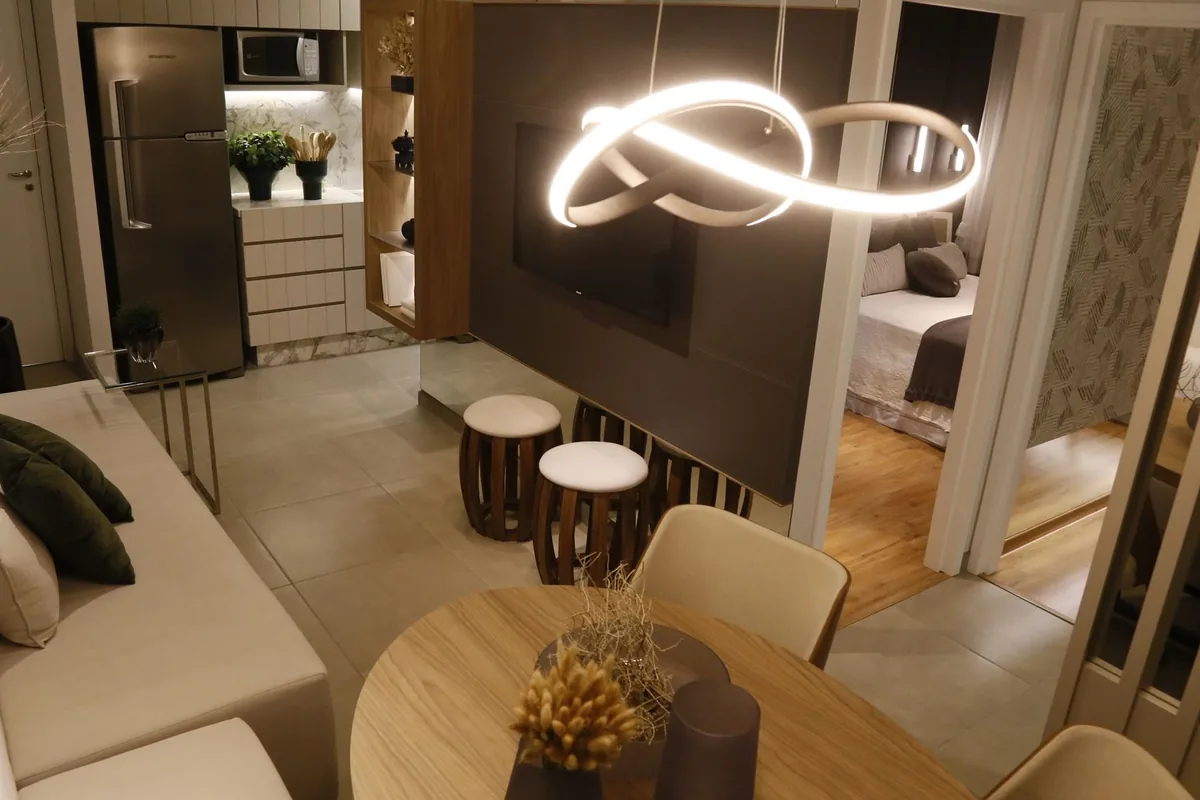
Let us translate dollars into homes. Around $650,000 to $750,000: a one bedroom or one bedroom plus den, typically 550 to 800 square feet. In Central Lonsdale, Lower Lonsdale or Lynn Valley you have real choice here, and a Central Lonsdale realtor is the fastest way to find out which buildings are worth a second visit. Newer buildings mean smaller units, older buildings mean more space and more maintenance questions. Our guide to the best areas for first-time buyers narrows the search down. Around $800,000 to $900,000: this is where two bedroom units become genuinely available. Expect 800 to 1,000 square feet in a 1990s to 2010s building, usually with a parking stall, sometimes with a view. Lynn Valley town centre, Central Lonsdale, Seylynn and Lions Gate Village all have inventory in this band. This is the strongest value zone for a $100,000 down payment.
For a closer look at the band just below it, read what $800K buys. Around $1,000,000 to $1,250,000: newer two bedroom condos in better buildings, waterfront adjacent units in Lower Lonsdale, and at the very top of the range the entry point into North Shore townhouses. Townhouse supply here is genuinely thin, roughly 170 active listings across the whole of North Vancouver in late summer 2026, so competition in this segment is stronger than in condos. What $100,000 down does not reach: detached homes. North Vancouver detached has been averaging around $2.4 million, which requires a down payment well north of $200,000 before you even discuss income. That is a different conversation and usually a different stage of life.
Which Limits You More: Your Down Payment or Your Income?
For almost everyone with $100,000 saved, income is the binding constraint. Here is why it is worth understanding rather than just accepting. Lenders do not qualify you at your actual mortgage rate. They qualify you at the stress test rate, which is the greater of 5.25 percent or your contract rate plus two percentage points. On a 4.5 percent mortgage, you are being assessed as though you were paying 6.5 percent. That is roughly a twenty five percent higher payment than the one you will really make. They also apply two ratios:
- Gross Debt Service (GDS), usually capped around 39 percent: your mortgage payment, property tax, heat and half your strata fees, divided by gross income
- Total Debt Service (TDS), usually capped around 44 percent: everything above plus car payments, credit cards, student loans and lines of credit
Two practical consequences. Strata fees eat your budget. Half your monthly strata fee counts in the GDS calculation. A building with $600 fees instead of $350 costs you roughly $40,000 to $50,000 of purchasing power. When comparing two units, compare the total monthly cost, not the price. Start with what strata fees cover and the monthly cost of ownership. Consumer debt is expensive twice. A $500 car payment can reduce your maximum mortgage by well over $100,000. Paying down or clearing a car loan before applying often does more for your buying power than saving another $10,000. If you want to move the ceiling, the levers in order of impact are usually: reduce other debt, add a qualified co borrower, choose a lower strata fee building, and use a thirty year amortization if you qualify. A broker can confirm your pre-approval amount before you start viewing.
How to Make $100K Go Further: Gifted Funds, the FHSA and a Mortgage Helper
Gifted down payment funds. Extremely common in Vancouver and fully acceptable to lenders. The giver signs a gift letter confirming the money is a gift with no repayment expected, and the funds usually need to be in your account for a short period before closing. Money that is actually a loan from family is a different thing and must be disclosed, because it affects your debt ratios. First Home Savings Account. $8,000 a year to a lifetime maximum of $40,000, tax deductible going in and tax free coming out for a qualifying home purchase. If you have not opened one and you are a first time buyer, this is the highest return move available to you. Two partners can build $80,000 combined. RRSP Home Buyers’ Plan. Up to $60,000 per person, tax free, repayable over fifteen years after a five year grace period. Two buyers can bring $120,000 combined, and it stacks with the FHSA.
A mortgage helper. In North Vancouver this usually means a legal secondary suite, which is out of reach at this budget, or a rentable second bedroom or a lock off. Some lenders will count a portion of documented rental income toward qualifying, which can raise your ceiling. Note that a rented room can also affect your principal residence exemption down the line, so understand the trade before you build a plan around it. Our guide to homes with a mortgage helper covers how lenders treat that income. Buy new to unlock the GST rebate.
The first time home buyers’ GST rebate returns the full federal GST on a new home up to $1 million, reduced between $1 million and $1.5 million. On a new $800,000 home that is roughly $40,000 of GST that you are not paying. Combined with the newly built home PTT exemption up to $1.1 million, new construction has become considerably more competitive for first time buyers than it was a few years ago. The rebate rules are explained in GST on new homes. Improve the qualification, not just the savings. Clear the car loan. Close the unused line of credit. Get the credit score above 680. These usually move your maximum price more than another year of saving does. The core real estate services we provide to our clients
- luxury house for sale
- commercial real estate services
- presale real estate services
- first time home buyer services
What Changes If You Look at Burnaby or Coquitlam Instead
Same $100,000, different geography, meaningfully different outcome.
| Market | What the same budget gets you | The trade |
| North Vancouver | One or two bedroom condo, $700,000 to $900,000 | The mountains, the trails, no bridge if you work locally. Least space per dollar |
| Burnaby (Brentwood, Lougheed) | Larger two bedroom, often newer, or an older townhouse at the top of the range | SkyTrain access, more new inventory, denser and busier. A North Burnaby realtor knows those pockets, and best SkyTrain neighbourhoods ranks them |
| Coquitlam and Port Moody | Two bedroom plus den, or a genuine townhouse at $900,000 to $1.1 million | Best space per dollar of the three, Evergreen Line, longer trips to the North Shore. Start with a Burquitlam realtor, or compare Burnaby vs Coquitlam first |
| Port Coquitlam and Maple Ridge | Townhouse comfortably, sometimes an older detached at the very top of the range | Real family space, real commute. Work with a Port Coquitlam realtor |
The honest way to make this decision: work out where you actually spend your week. If your job, your family and your life are on the North Shore, the two bridges are a daily cost that a bigger kitchen in Coquitlam does not offset. Actual travel times are in commuting to downtown. If you commute east or work from home, the value case for looking outside the North Shore is genuinely strong and worth taking seriously rather than dismissing. Our ranking of the most affordable cities is the place to start.
Frequently Asked Questions
Is $100,000 enough for a down payment in Vancouver?
Yes, comfortably, for a condo. Minimum down payment rules mean $100,000 technically supports up to a $1.25 million purchase. What decides your real ceiling is income and the stress test, not the savings.
Do I need twenty percent down?
No. Twenty percent avoids mortgage default insurance and gives a lower payment, but it also means buying much less home. With $100,000, twenty percent down caps you at $500,000, which is very limiting in North Vancouver. Most buyers at this level use an insured mortgage deliberately.
How much is CMHC insurance on my purchase?
It depends on the down payment percentage: 4.00 percent of the mortgage at 5 to 9.99 percent down, 3.10 percent at 10 to 14.99 percent, and 2.80 percent at 15 to 19.99 percent. On an $800,000 purchase with $72,000 down, that is roughly $31,000, added to your mortgage rather than paid in cash.
Can my parents give me the down payment?
Yes. Gifted funds are standard and accepted with a signed gift letter stating the money is not repayable. If it is actually a loan, it must be declared, and it will reduce how much you qualify for.
Does the FHSA money count as my down payment?
Yes. Qualifying withdrawals come out tax free and go straight into your purchase. You can combine an FHSA withdrawal with an RRSP Home Buyers’ Plan withdrawal on the same purchase.
What income do I need for an $850,000 condo?
Roughly $175,000 to $185,000 in household income with about eight percent down and a thirty year amortization, depending on the strata fee, property tax and any other debt you carry. A high fee building pushes that number up.
What if I am self employed?
It is workable but the documentation is heavier. Lenders typically want two years of notices of assessment and financial statements, and they use your net income rather than your gross revenue. Some lenders have specific self employed programs. Talk to a broker early rather than late.
Should I use a thirty year amortization?
If it is the difference between buying and not buying, yes, and you can always prepay later. If it is only being used to buy a more expensive place than you need, be careful, because the extra interest over thirty years is substantial.
How long does a pre approval last?
Usually ninety to one hundred and twenty days, and it holds a rate for that period. It is not a guarantee of financing, since the lender still has to approve the specific property, but it tells you your real number and it makes your offers credible. Skipping it is one of the classic first time buyer mistakes.
Is it better to buy a smaller place now or wait and buy bigger?
There is no universal answer, but the practical case for buying now is that you start building equity and you stop being exposed to rent increases. The practical case for waiting is that stretching into a home you can barely carry is how people end up forced to sell. Buy what you can carry comfortably, not what you can barely qualify for. If renting is still on the table, buying vs renting compares both paths.
Let’s Map Your $100K to Real North Vancouver Listings
Everything above is arithmetic. What it cannot tell you is which specific buildings are worth your money, which ones have a levy coming, and which listings are quietly negotiable right now. Navid Hakimi does that part. As a top one percent Greater Vancouver realtor with more than one hundred verified five star reviews, closing over ninety solo transactions a year across North Vancouver, West Vancouver, Burnaby and the Tri Cities, Navid works with first time and move up buyers on exactly this budget every month. A free consultation gives you:
- Your real maximum price, worked out with a mortgage professional against the stress test rather than a rough online calculator
- A shortlist of buildings in your range that have healthy reserve funds and no nasty surprises in the minutes, screened with the same condo buyer checklist we use on every purchase
- A savings plan, if you would be better off waiting three months to claim an exemption or clear a debt that is capping your budget
- A comparison across markets, so you can see honestly what the same $100,000 does in North Vancouver versus Burnaby or the Tri Cities before you decide
Zero obligation. Call 604 347 6084 or reach out through navidhakimi.com, and let us turn your $100,000 into a real list of addresses. You can start browsing the MLS search in the meantime.